

Which Supply Route Fits Your Small Clothing Store?
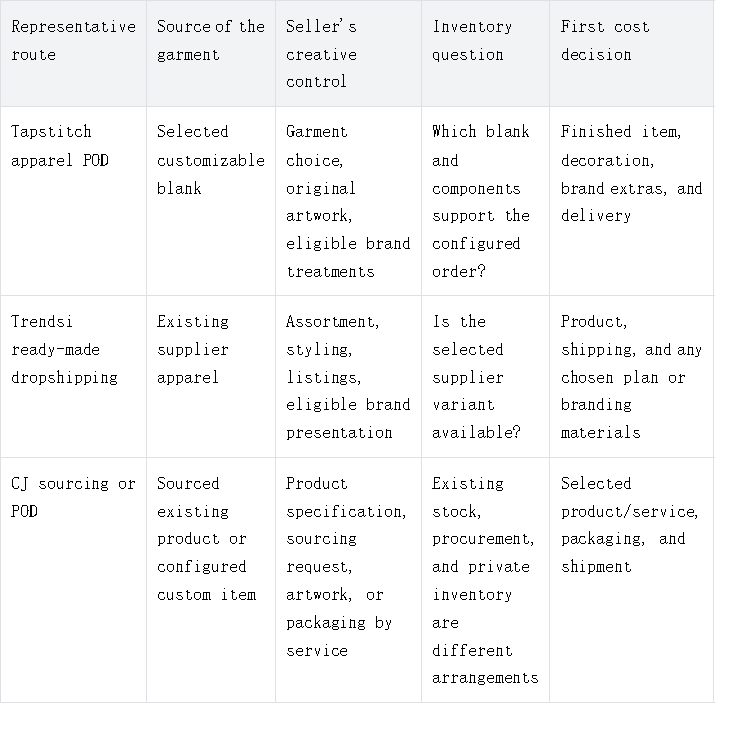
Start with Tapstitch when your own graphics and chosen apparel blanks define the store. Start with Trendsi’s dropshipping route when the business is a curated boutique selling ready-made clothing. Consider CJdropshipping when sourcing and several product or customization routes are part of the plan. These are representative services, not exclusive descriptions of the three companies: Trendsi also offers wholesale and made-to-order routes, and CJ offers Print on Demand.
The useful question is what makes the product yours. A store can create value through original artwork, through selection and styling, or through a sourcing specification. Each route gives the seller different control over the garment and different work to manage. Avoiding stock in your own premises changes fulfillment; it does not remove the need to fund orders, maintain accurate listings, or help customers.
For a small team, that distinction should come before comparing app features. A simple store with a clear product promise is easier to evaluate than a broad assortment assembled from services whose inventory, branding, and returns conditions differ. Choose the route that supports the promise and fits the team’s operating capacity.
Compare What You Can Change About the Product
Dropshipping describes who sends the product to the customer. Print on Demand describes a production or decoration trigger. Private labeling describes a brand treatment. Sourcing describes how a product is obtained. A store can combine these arrangements, so the company name alone does not identify the product model.
A branded invoice is not a redesigned garment. A neck label is not an original pattern. An uploaded graphic can create a distinctive visible product without making the underlying blank exclusive. Assess product originality and brand presentation separately, then decide whether the route provides enough control for the store you want to build.
Tapstitch: customize eligible apparel on demand
Tapstitch’s apparel workflow starts with choosing a garment, adding a design, and using the platform’s production and delivery service. Its one-item ordering route makes it possible to start with a small configured assortment. The seller’s main creative levers are garment selection, artwork, and applicable brand treatments.
A graphic-led store can use that route to build a recognizable product language. The blank still needs to suit the design: sleeve shape, body proportions, material, and decoration position influence the resulting product. Uploading artwork onto an existing garment is a different development task from commissioning a new pattern and fabric.
The Tapstitch label guide connects custom labels to international fulfillment. That condition matters when the label is essential to the product. Choose the identity and production route together rather than expecting a domestic blank order to carry every possible brand treatment.
Trendsi: curate ready-made apparel with eligible branding
Trendsi describes a supply service that includes dropshipping and open-pack wholesale. For a ready-made boutique, the creative work is selecting garments that belong together, presenting their fit and styling clearly, and serving the customer. It does not require applying a custom print to every item.
Its product-page guidance distinguishes branded products from overseas white-label products and displays supplier, variant, stock, and order information. Those details help a seller determine whether the item will arrive with an existing brand identity or qualify for another presentation route.
Trendsi’s branding FAQ separates its free branded invoice from other materials. Custom branding is tied to overseas-warehouse products, with sewn labels and hang tags limited to eligible apparel orders. The FAQ also says sewn labels currently do not support the logo option. A store requiring a graphic logo inside every garment should not treat those labels as equivalent to every other supplier’s service.
Choose dropshipping, wholesale, or made-to-order deliberately. Moving to another Trendsi service can change the purchasing commitment and product control, even though the store remains connected to the same company.
CJdropshipping: define the sourcing or customization route
CJ’s POD service describes apparel and other custom products with artwork, production, and fulfillment. Its wider service also supports finding and ordering existing goods. A ready-made item, a sourced specification, and an artwork-customized garment require different decisions.
For an existing product, define the exact variant, supplier availability, and delivery destination. For a POD product, define the artwork and supported decoration. For a sourcing request, describe the requested material, measurements, and modifications instead of treating “custom” as a complete specification. A broad sourcing service is not itself evidence that a particular original garment can be developed at one-piece quantity.
CJ’s custom-packaging workflow includes purchasing packaging, receiving it at the warehouse, and connecting it to the product orders. That can support a store identity, but it introduces a material purchase and supplier-side inventory. The seller may hold no garments at home while still funding a stock of packaging.
This route suits a team prepared to distinguish the arrangements product by product. Its breadth is useful when the business needs sourcing choices; it also means the store should not publish one universal customization or delivery promise for everything listed.
Follow the Stock, Cash, and Store Connection
Map the order before deciding which service is easier. Record who maintains the listing and variant connection, who holds the garment or components, when the supplier is paid, and how tracking reaches the storefront. A connected app does not remove those decisions.
Trendsi’s Shopify fulfillment guidance describes store orders syncing to its app, followed by payment for processing, with an optional automatic checkout setting. CJ’s Shopify guidance describes store authorization and product connections. Tapstitch’s workflow also includes connecting the store and sending orders for production. In each case, the listing, paid order, supplier submission, and tracking should describe the same variant.
Keep garment inventory separate from brand-material inventory. Ready-made dropshipping relies on supplier stock. An on-demand garment relies on a viable blank and production configuration. Purchased packaging or labels rely on materials stored for later use. Those are different availability risks, even when the seller stores none of them personally.
For costs, start with the configured product and destination. Add decoration where applicable, brand materials, shipping, required setup, chosen subscriptions, and the cash needed to pay orders before storefront proceeds are available. Compare the complete arrangement rather than a product price from one company with a partly configured item from another.
Trendsi’s current plans list a Free plan at $0 per month and a Pro plan at $29.90 per month. Its branding FAQ separates free invoices from paid material purchases. These are different cost categories: subscription access, product purchases, shipping, and materials should remain separate in the cash plan. Pricing here is a US-dollar snapshot from October 14, 2026, rather than a reason to assume a launch has no expense.
Maintain an order-funding reserve and define its purpose. It should support supplier charges and the exceptions your customer policy requires, not an assumed profit figure. A store can avoid prebuying clothing and still need funds for samples, order timing, and customer remedies.
Compare Delivery and Customer Problem Ownership
The supplier may prepare and ship the parcel, but the store communicates the delivery promise. Separate production or procurement, carrier transit, split parcels, and tracking. The route used for one product should govern its own delivery description.
Trendsi’s shipping guidance distinguishes US and overseas products and charges dropship shipping by order weight. Its US return policy accepts eligible unworn items under stated conditions, does not offer exchanges, and sets a seven-day request window. The store still handles the customer’s communication and refund transaction on its own side.
Tapstitch’s returns FAQ distinguishes manufacturing defects and order errors from direct customer returns: the reseller manages customer returns under the store’s policy. That makes sizing information and the retailer’s remedy choices important before launch.
CJ’s dispute policy uses a refund, resend, and return process with evidence requirements and exclusions. It distinguishes damaged, wrong, or missing products from reasons such as a buyer disliking an item or selecting the wrong SKU. A store should preserve the complaint, order details, and relevant images rather than promise the same supplier remedy for every customer issue.
Write your response process around those differences. Identify who receives a customer request, who submits a supplier claim, what evidence is needed, and who issues the customer remedy. The purpose is a usable service plan, rather than a claim that outsourcing shipment outsources responsibility.
Choose by Product Differentiation and Team Capacity
Ask what your team can approve before launch and maintain after it. For an original-graphic route, the approval includes the blank, artwork, identity, and production configuration. For a curated boutique, it includes the assortment, supplier variant, stock connection, and size description. For a sourcing-led store, it includes the specification and the particular procurement or customization agreement.
Next, identify the task the team has the least capacity to absorb. If it cannot monitor several inventory and product connections, reduce the assortment or the number of arrangements. If it cannot carry prepaid branding materials, start with a presentation route whose cash commitment fits the launch. If it cannot support a complicated return path, choose products and customer terms that make the response workable.
Tapstitch, Trendsi, and CJ should then be evaluated against that defined operating plan. A supplier that fits the product idea but exceeds the team’s capacity is a poor first-launch choice; the same route may become useful later when the store has stronger processes. Keep that distinction visible when adding another service instead of treating expansion as an automatic upgrade.
Before expanding, trial one representative product through the customer order path. Approve the product, observe the actual cash sequence, and document the exception response. A small store’s supply partner should make its product promise workable without adding more operational complexity than the team can sustain.